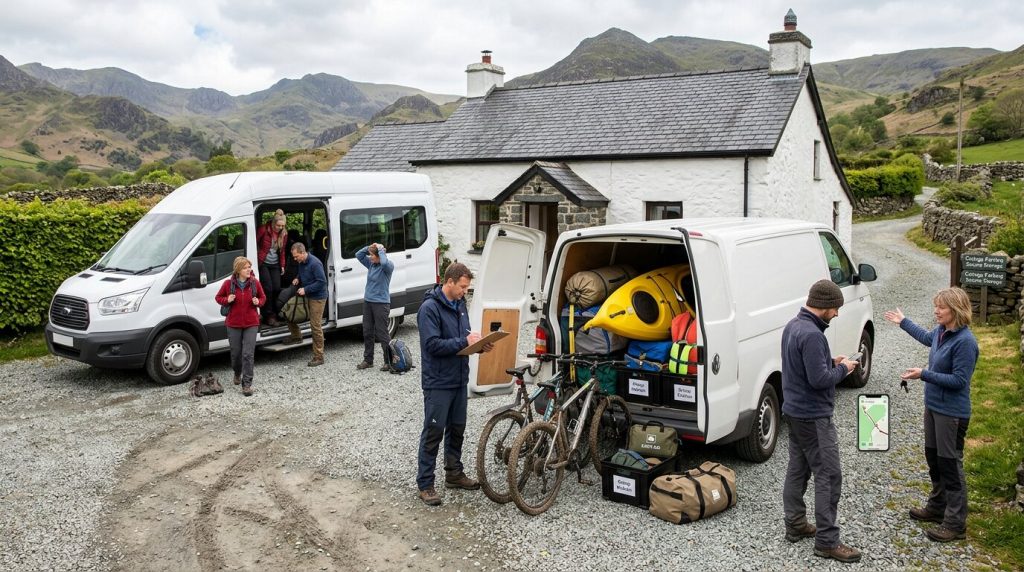


Group trips tend to go smoothly or badly on the strength of decisions made weeks before anyone sets off. In Northern Ireland, one of the first is how everyone will travel. Whether the plan is a weekend on the north coast, a wedding near Derry/Londonderry or a club outing from Ballymena, someone usually ends up asking the same thing: one minibus, or several cars?
This note works through that choice for groups travelling by road within Northern Ireland. It uses nidirect’s Northern Ireland guidance on licences and seat belts, so check the equivalent rules if your trip starts or ends elsewhere.
For most groups the decision comes down to two numbers: how many passengers you have, and how many of them hold the right licence to drive. Up to eight passengers, a single large car or a nine-seat minibus can usually be driven on an ordinary car licence. Once you need nine to sixteen passenger seats, the driver normally needs minibus entitlement, and that rule settles the question for a lot of groups before cost even comes into it.
Luggage is the second filter. A vehicle that seats everyone may not carry everyone’s bags, so it pays to plan the two together.
The licence line that decides most trips
A standard category B licence covers vehicles with up to eight passenger seats and a maximum authorised mass of 3,500kg for petrol and diesel vehicles, according to GOV.UK’s licence categories page. That takes in large cars, people carriers and nine-seat minibuses (eight passengers plus the driver).
Above that, nidirect’s guidance on driving a minibus says a minibus with nine to sixteen passenger seats normally needs category D1. The guidance distinguishes earlier D1 entitlements from a conditional exemption for volunteer drivers:
- Drivers who passed their car test before 1 January 1997 may have D1 with restriction code 79 (“not for hire or reward”), which means no payment of any kind from passengers. Drivers over 70, or with a medically restricted licence, must meet higher medical standards to keep it.
- Drivers aged over 21 who have held a full car licence for at least two years may drive a minibus on a voluntary basis, for social purposes, on behalf of a non-commercial organisation. They can receive nothing beyond out-of-pocket expenses, the minibus must weigh no more than 3,500kg excluding any specialist equipment for disabled passengers (4,250kg including it), no trailer can be towed, and the rule applies only within the UK.
Do not apply the volunteer-organisation example automatically to a private or family trip. Check the current Northern Ireland guidance for that use and confirm any applicable exemption with DVA. If no driver has the necessary entitlement or meets an applicable exemption, use vehicles with eight passenger seats or fewer, or book a minibus with a professional driver. If a hire website suggests a larger minibus can be driven on a car licence, ask the hirer to explain exactly which rule they are relying on, and check your licence entitlement against nidirect and the hirer’s terms before you book.
Count seats and bags together
Write down every passenger, then every bag, and be honest about the bags. Golf clubs, prams, wheelchairs and sports kit change the picture more than suitcases do. Hire vehicles are usually configured for maximum seats, which leaves less room behind the last row than people expect.
| Group (including driver) | Light luggage (day bags only) | Heavy luggage (suitcases, clubs, kit) | Licence point to check |
|---|---|---|---|
| Up to 5 | One car | One estate car, or a seven-seater with the rear row folded | Category B |
| 6 to 7 | One seven-seater | A nine-seater, or two cars | Category B |
| 8 to 9 | One nine-seater | A nine-seater plus a car for bags, or two seven-seaters | Category B (eight passenger seats maximum) |
| 10 to 17 | A 12 to 17-seat minibus, or two nine-seaters | Two vehicles, or a minibus with confirmed rear luggage space | D1 normally needed for the minibus; two nine-seaters need two category B drivers |
Treat the table as a starting point, not a specification. Seat layouts and boot space vary by model, so ask the hirer how much luggage room is left when every seat is in use.
Compare the driver arrangements, not just the price
One minibus means one driver for the whole trip. That driver can’t drink, can’t nap and is responsible for everyone’s day. Several cars spread the driving but also split the group, which matters if you’re following a route along the coast or parking at busy venues.
A hypothetical example: a club of eleven travelling from Ballymena to an event near Derry. A 12-seat minibus keeps them together, but only works if a member holds D1, or if the trip genuinely meets the voluntary, non-commercial conditions above and the hirer accepts that. Without that, two nine-seaters or a nine-seater and a car do the same job with two category B drivers, at the cost of a second set of fuel, parking and insurance.
Ask about additional drivers early. Most hirers set a minimum age and a minimum period of holding a full licence, and larger vehicles often carry stricter conditions.
Two enquiry starting points
The table below lists two vehicle-hire websites you could use as a starting point for enquiries. They cover different vehicle types in different towns, and the comparison here is about vehicle type only, not about the businesses.
| Vehicle type | Enquiry website | Questions to raise |
|---|---|---|
| Seven to 17-seat passenger vehicles, Derry / Londonderry | Derry / Londonderry minibus hire options | Which seat count you will get, the licence required for that exact vehicle, the driver age rule and luggage space with all seats occupied |
| Cars, Ballymena | car hire information for Ballymena | Whether two cars can be booked for the same dates, additional drivers, delivery arrangements and the return time |
Get the answers in writing, and check the deposit, the insurance excess and what happens if you return late.
Questions to ask before you book
- How many passenger seats does the specific vehicle have, and what licence category does it need?
- What are the minimum age and licence-holding period for each driver?
- How much luggage fits with every seat in use?
- Does every seat have a seat belt? On a minibus, passengers must wear one if fitted, and passengers aged 14 and over are responsible for wearing their own, according to nidirect’s seat belt guidance.
- Are child seats available, and who fits them?
- Is the vehicle allowed across the border into the Republic of Ireland, and does the insurance cover it?
- Where can a minibus be parked at your destination? Height limits and narrow car parks rule out some venues.
When neither option is right
If the group is large, the drivers are reluctant, or everyone wants to enjoy the day without someone staying sober, a coach or minibus with a professional driver may be the simpler answer. Self-drive saves money only when someone in the group is legally able and genuinely willing to drive it. Work that out first, and the vehicle choice usually follows.