
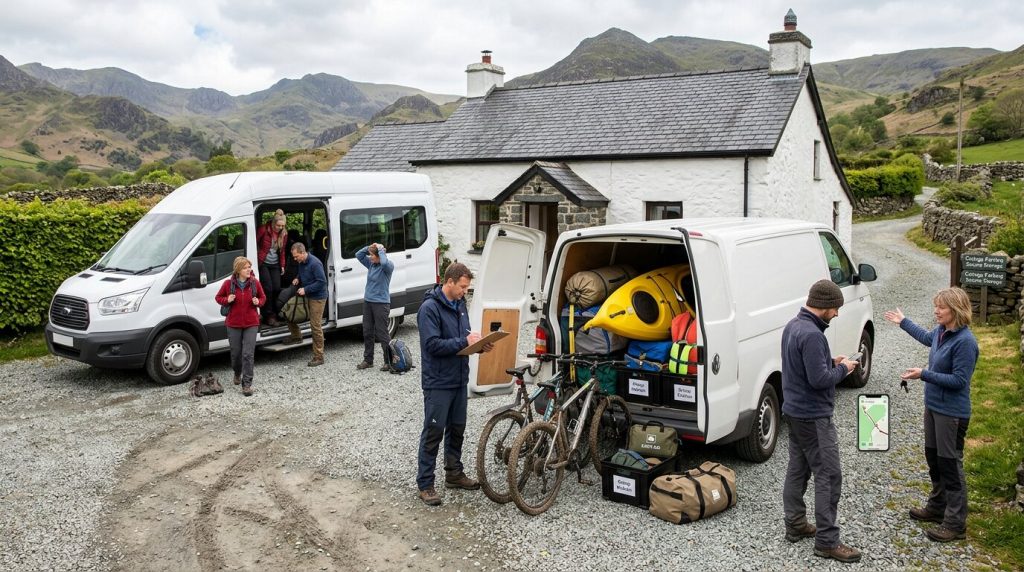
When a group is meeting in Eryri from Cardiff, Ceredigion and somewhere in between, the question isn’t really “which vehicle?” It’s “who is responsible for what?” Give one person the passengers, one person the shared equipment and one person the timings, and most of the awkward decisions make themselves.
The questions below are the ones that tend to come up once a group starts planning. The answers keep two things apart throughout: vehicles that carry people, and vehicles that carry kit.
What are the transport jobs on a group break?
There are usually four, and on a small trip one person can hold two of them.
| Role | Responsible for | Vehicle | Must confirm before travel |
|---|---|---|---|
| Passenger driver | Collecting people at agreed pick-up points and getting them to the base | Car, people carrier or minibus | Licence covers the number of passenger seats; every driver is on the hire agreement |
| Kit driver | Shared equipment: bikes, boats, tents, group cooking gear, first-aid kit | Van (load area carries equipment only) | Load length and payload of the actual van; how the load is secured |
| Route lead | Timings, meeting points, roadworks, fuel stops | Rides with either driver | Live road information on the day |
| Base contact | Parking at the accommodation, overnight kit storage, check-in time | None | How many vehicles the property can take and where |
Write names into the table before anyone books anything. It is the easiest way to spot that, for example, nobody has agreed to drive the van home on Sunday.
Should people and equipment travel together?
Not if the equipment is bulky. A minibus’s luggage space is sized for bags, and seat counts say nothing about room for bikes or paddleboards. Once kit starts going on spare seats, it’s using space meant for people and it may not be properly held in place.
A separate van also suits groups coming from different directions. A hypothetical example: nine people from Cardiff and two from near Lampeter are heading north for a long weekend. The Cardiff group travels together in one passenger vehicle. The Lampeter pair collect the shared kit and bring it up in a small van. Nobody sits among the bikes, and the kit arrives with the two people who packed it.
Who can drive a minibus?
This is the question to settle first, because it decides the vehicle size. A standard category B licence covers vehicles with up to 8 passenger seats, according to GOV.UK. Category D1 covers up to 16 passenger seats. So a driver with only a car licence can take a vehicle with up to eight passengers, which is a nine-seater counting the driver.
GOV.UK’s driving a minibus guidance explains a narrow exception that lets car licence holders drive a minibus with up to 16 passenger seats. It only applies with no payment from or on behalf of the passengers, a driver aged 21 or over who has held a licence for two years, voluntary driving for a non-commercial body for social purposes, no trailer, and a maximum authorised mass of no more than 3,500kg (4,250kg for electric or hydrogen vehicles). Drivers over 70 must also meet Group 2 medical standards. A group of friends splitting the cost of a hire is unlikely to meet those conditions. Outside those conditions, check which driver entitlement or exemption applies; D1 may be required. Another option is a minibus that comes with a professional driver. A minibus permit doesn’t replace the driver’s own entitlement. Check each driver’s licence and the hirer’s terms rather than assuming.
Where can the Cardiff group look for a minibus?
Start with the vehicle size your drivers can legally use, then ask about luggage room with every seat filled. The Cardiff minibus hire enquiry page lists vehicles from 7-seat people carriers up to 17-seat minibuses, and sets out its own age and licence requirements for the larger sizes. Ask which exact vehicle you’ll get, how many large bags fit with all seats in use, what the insurance excess is and whether delivery is available to your pick-up point.
Where does the kit van come from?
Ideally from whoever lives nearest the kit. If your gear is stored in mid Wales, a van collected there saves a detour. For that area there is van hire information for Lampeter, which describes a range from compact vans to Luton box vans with tail lifts. Before booking, measure the longest item, ask for the payload of the specific van and agree where it will be parked at the accommodation.
How do we keep the two vehicles in step on the day?
Agree one meeting point near the base rather than trying to travel in convoy. The route lead should check Traffic Wales for incidents and roadworks before both vehicles set off, and again at the halfway stop. Share the van’s arrival estimate with the base contact so the parking space is clear.
What should we sort out about returns?
- Return times for each hired vehicle, set against when its driver is actually free.
- Who takes the shared kit home, and whether that changes the van’s return point.
- Photos of both vehicles, inside and out, at collection and at return.
- Fuel levels as agreed in each hire contract.
Is all this worth it for one weekend?
Usually, yes. A fifteen-minute call to fill in the role table costs far less than the arguments it prevents. The group arrives together, the kit arrives with the people who packed it, and Sunday afternoon has a plan as well as Friday night.
